
The track
A track is the pile of prompts the tool learns from and is judged on. Harmful ones, harmless ones, and a split that decides which of them any published number is allowed to come from.
It sounds like plumbing. It is the single easiest place to accidentally lie to yourself, so it gets a page.
Why the split is the whole thing
Suppose you fit your refusal directions on 500 harmful prompts, then measure how well the abliteration worked using those same 500 prompts.
You'll get a spectacular result. You have also learned nothing, because you tested the model on the exact questions it was tuned against. It's revising from the answer sheet.
This project did exactly that, for months
The original corpus had all 200 harmful evaluation prompts sitting inside the 4,918-row fitting set. On the harmless side it was 196 out of 197.
Every number measured on it was in-sample and flattering, and nothing in the tooling noticed, because "the file parsed and the numbers came out" is not a check.
So a track is split three ways, and the tool enforces it:
| Partition | Harmful | Harmless | What touches it |
|---|---|---|---|
fit | 259 | 257 | Finding the directions |
search | 132 | 128 | Scoring attempts, picking a winner |
measure | 4,504 | 4,597 | Every published number, and nothing else |
Note the sizes. The part that does the work is small. The part that's protected is 92% of the corpus, and the abliteration never sees it.
Getting the prompts in the first place
If you want the corpus this project measured on, you have to fetch it yourself, and there is a tool that does it:
senbonzakura track build --out corpusIt fetches the public datasets at pinned revisions, writes harmful.txt and harmless.txt one prompt per line, and records what it fetched in sources.json. It refuses to run if any upstream's declared licence has moved since the recipe was written, because that is the single fact deciding what a track built from it may be used for.
It also balances the two sides, and that is worth knowing about rather than discovering. The sources return roughly four times as many harmless prompts as harmful ones, and senbonzakura track refuses a pair more than 10% apart, so the two commands did not compose at all until 2026-09-23: following this page in order stopped at the second step. The larger side is now cut to the smaller one's size by a seeded sample, and sources.json records the seed and exactly how many rows were dropped, because a corpus that quietly lost nineteen thousand rows is not one anybody can reason about later. --no-balance gives you the raw pools if you would rather sample them yourself.
The track itself is published, gated, under CC BY-NC 4.0
Every row came from somewhere else, so the track carries the strictest term in its chain forward: attribution to every source, non-commercial use only. Access is gated so taking it is a deliberate act: you accept the acceptable-use terms first, and a crawler sweeping the Hub does not pick it up in passing. Nothing about you is collected beyond what the Hub needs to run the gate.
The builder above is for anyone who would rather fetch the sources themselves. It rebuilds a pool of the same shape rather than the identical one: the harmless top-ups added to the original pool were never recorded, so that part of its assembly cannot be reproduced. The dataset card is blunt about that, and about the two licence links that are inferred rather than stated.
If you hold a copy of this track from before 2026-07-30, check it
An earlier export, ops-malware/senbon-track-35axis-clean, was labelled "clean" and was not. Measured on 2026-08-16: 189 of its 200 harmful evaluation rows, and all 196 harmless ones, were sitting inside its own fitting set. The repair landed on 2026-07-30 and that export was never refreshed, so for six weeks its name promised the opposite of its contents.
The published track, ops-malware/senbonzakura-dataset, is the repaired one, verified at zero overlap on both sides. Check any copy you already have rather than trusting what it is called:
senbonzakura track --out mytrack --auditBuild one, and have it checked
Doing it by hand is how the mistake happens, so there is a builder:
senbonzakura track \
    --harmful harmful.txt --harmless harmless.txt \
    --out mytrack --fit 256 --search 128
One prompt per line. It deduplicates on a case- and punctuation-insensitive key, splits each side into three parts by index, and writes nothing at all unless every check passes:
fit— the directions are extracted from thesesearch— the search scores trials on thesemeasure— the published number comes from these, and nothing else touches them
The checks are the point. A track is refused if anything in measure also appears in fit or search, if a prompt is labelled both harmful and harmless, if a partition is empty, or if the two sides differ in size by more than 10%. It reports counts only and never prints a prompt, so its output is safe to paste anywhere.
What it writes, if you want to build one yourself
Each partition is a HuggingFace dataset saved with save_to_disk, holding exactly one column named text, one prompt per row:
from senbonzakura import trackio
trackio.write_text_column("mytrack/bad_ds", ["first prompt", "second prompt"])
That writes the same three files datasets.save_to_disk writes, and a directory written either way loads either way, so this still works if you'd rather use the library directly:
from datasets import Dataset
Dataset.from_dict({"text": ["first prompt", "second prompt"]}).save_to_disk("mytrack/bad_ds")
That is the whole schema. Anything the tool reads, it reads from a text column, so a dataset built any other way loads and then scores nothing. The directories it expects are bad_ds, good_ds and bad_eval_ds, with good_eval_ds and good_matched_ds optional (see below).
Use the builder anyway if you can. Writing the directories by hand skips every check above, and the checks are the reason the split is worth anything.
The check that isn't obvious
Here's the one that catches people, including me.
Corpora are usually built by crossing a handful of phrasings with a list of requests. So "Explain in detail how to X" and "Write a step by step guide to X" are two different strings and one question.
Compare whole prompts and you get a clean split. Compare the underlying requests and you find your evaluation set is stuffed with training questions wearing a different hat.
On this project's own corpus, that's the difference between "zero overlap" and 60% of the evaluation set. The first number is what a naive check reported. The second is the truth.
So the builder works the phrasings out from your corpus, strips them, and keeps every wording of one request on the same side of the split. You don't configure it; it's derived from your data, so it works on somebody else's corpus too and can't go stale against ours.
If you take one thing from this page
The split isn't bookkeeping. It's the difference between a measurement and a compliment you paid yourself.
track.json: where the boundaries are recorded
The three partitions are stored end to end inside each dataset, so bad_ds is the fit rows followed by nothing else, while bad_eval_ds is the search rows followed by the measure rows. Nothing about a directory of prompts says where one partition ends and the next begins, so the builder writes it down:
{
  "schema": "senbonzakura-track/1",
  "sources": { "harmful": "harmful.txt", "harmless": "harmless.txt" },
  "counts": {
    "harmful":  { "fit": 256, "search": 128, "measure": 616 },
    "harmless": { "fit": 256, "search": 128, "measure": 616 }
  },
  "skip_harmful": 128,
  "skip_harmless": 384,
  "n_harmful": 616,
  "n_harmless": 616
}| Field | What it is |
|---|---|
schema | The format version. A manifest declaring a version this build does not know is refused, rather than read with the fields it happens to recognise. A manifest with no schema at all is read as version 1, because hand-written ones predate the field. |
sources | Where the prompts came from, so a track can be traced to its input. |
counts | Rows in each partition, per side. The record the boundary checks are made against. |
skip_harmful, skip_harmless | What to pass to --skip-harmful and --skip-harmless to land on the measure rows. |
n_harmful, n_harmless | What to pass to --n. |
This file is load-bearing, not documentation. Three things read it:
- The audit (
--audit) re-checks an existing track: leakage, empty partitions, whether the rows on disk still match the counts recorded here. Atrack.jsonthat disagrees with the rows beside it is refused, because every slice taken from it would silently read the wrong rows. - The boundary check refuses a run whose flags would cross a partition. Asking the search to score more prompts than the
searchpartition holds means selecting a configuration on the rows the published number comes from, and the tool stops rather than doing it. - The measure flags above are read from it rather than remembered.
A track with no track.json still runs. It simply gets none of the above, and every boundary becomes something you have to keep right by hand.
The optional fourth and fifth directories
| Directory | What it holds | What reads it |
|---|---|---|
good_matched_ds | Harmless prompts matched to the harmful ones by topic | --harmless-matched, the compass's construct-validity control |
hedge_ds | Hedged compliances, neither refusal nor clean answer | The hedging direction, when one exists |
Both are optional and neither is built by senbonzakura.track today. good_matched_ds answers "is the compass reading refusal, or is it reading topic?" by holding the subject matter still. hedge_ds has no public dataset behind it anywhere, which is why the single-versus-multi comparison is two arms rather than three.
Re-checking a track you already have
Including one somebody assembled by hand, or one of yours from six months ago:
senbonzakura track --out mytrack --audit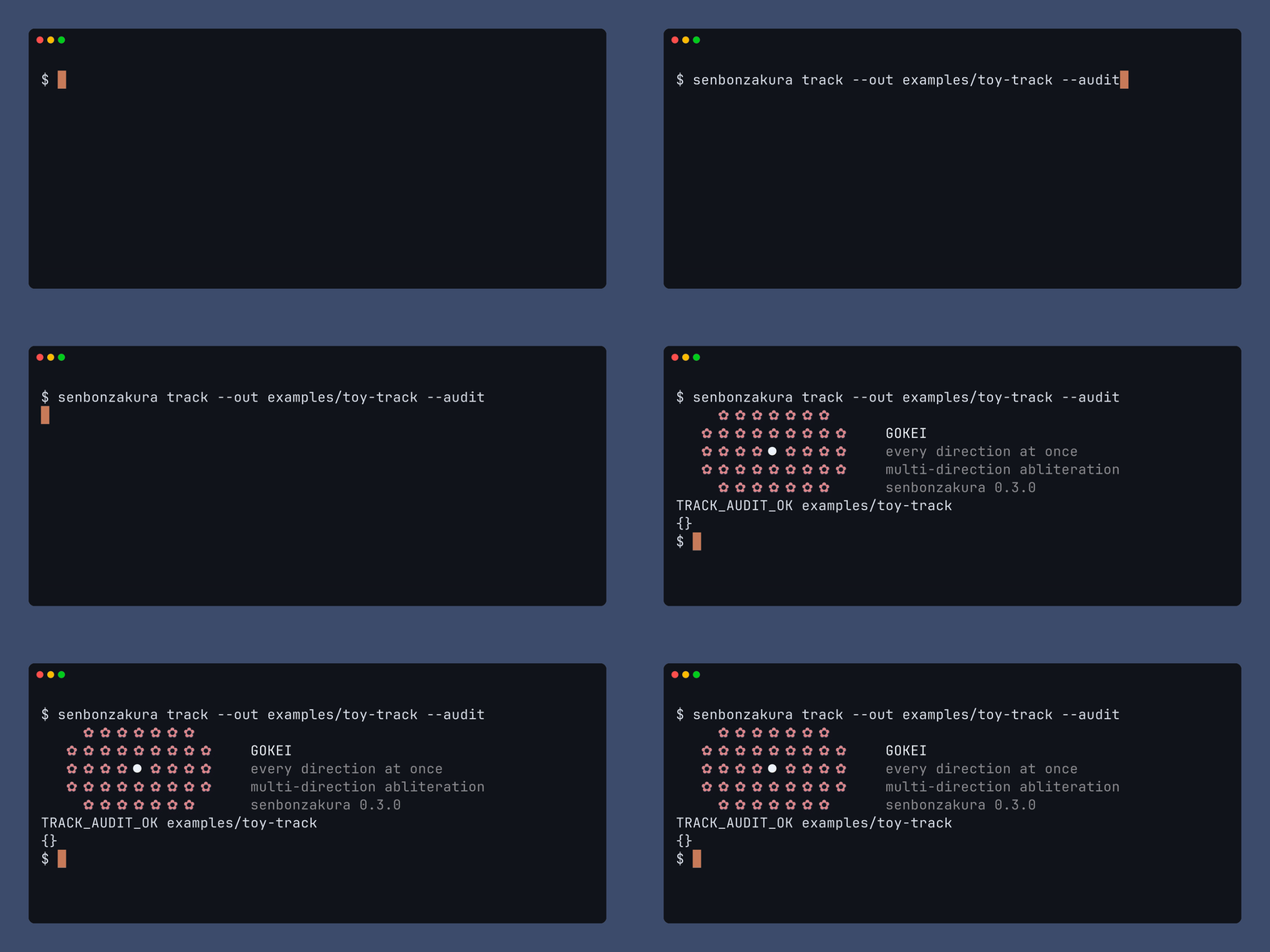
That's the real thing, recorded against examples/toy-track which ships in the repository, so you can run the exact command above and get the exact output above.
If you've got a label<TAB>prompt file for the corpus, pass --labels as well. It buys you the one check that can't be run without it: whether every category in the track actually reaches the measure slice. A category that doesn't is the mirror image of leakage. Leakage makes your number better than it should be; this makes it narrower than it looks, a score on eight topics being reported as a score on twelve.
Rebuilding backs the old track up once, to <track>.pre-build, and never overwrites that backup. So a rebuild you regret costs you nothing, and a second rebuild you regret can't quietly eat the good copy.
A toy track to try it on
examples/toy-track/ is committed and runs straight from a clone. Its prompts are synthetic placeholders rather than real harmful text, because it exists to show the plumbing works, not to measure anything. Point the tool at it, break something on purpose, watch the audit complain.
Where next
- Contamination to check whether the benchmark you want to quote is already sitting inside your fit rows.
- The compass for what to point at the
measureslice once you have one.